Land, belonging, and use
The LuminariesIn The Luminaries, land is both a material resource and a measure of competing ideas of belonging. The British Crown’s purchase of Poutini Ngāi Tahu territory and the subsequent sale of land to settlers turn occupation into legal title and economic return; Te Rau Tauwhare’s response insists on a different measure, grounded in use, familiarity, and attachment. The contrast is sharpened by the Arahura Valley, where Crosbie Wells’s home and property sit beside land from which Tauwhare’s people have been confined.
Purchase, title, and dispossession
Six years before the events described, the British Crown purchased an extensive tract of the western South Island from Poutini Ngāi Tahu for three hundred pounds. The people retained the Arahura River, portions of its banks, and a small parcel at Mawhera, near the mouth of the Grey River. The original negotiations had seemed unfair; in retrospect, the scale of the bargain made its character as dispossession unmistakable. Gold-seekers arriving later paid a pound each for prospecting licences and ten shillings per acre for land. Those revenues were considerable, while the aggregate value of the gold in rivers and sands remained so vast that it had not yet been calculated.
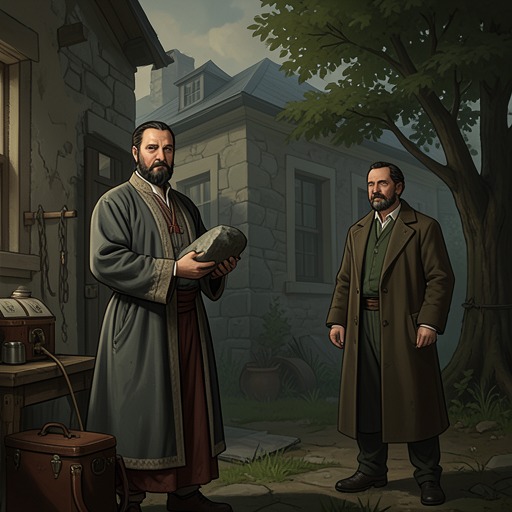
The system converts land into a source of state income and private wealth while leaving the people whose territory it was with a sharply reduced holding. The Arahura River remains especially significant within that altered geography: Tauwhare travels there to seek pounamu, a valued stone found in its riverbed. His practiced eye lets him recognize stones whose plain exteriors conceal a green interior, and he carries them back to Mawhera for ceremonial blessing and breaking. The river is therefore not simply a boundary or a prospecting ground; it is a place of material and cultural relation.
Wells’s purchase and the valley
Crosbie Wells paid the British Crown fifty pounds for one hundred acres at the eastern end of the Arahura Valley, land thick with totara. He built a one-room cottage overlooking the river, cleared a garden, and began constructing a timber mill. His purchase is legally recognized, and his work gives the acreage a practical life: a dwelling, cultivation, and an attempt at production. Yet the property also borders land to which Poutini Ngāi Tahu had been confined, making the lawful transaction part of a larger history of unequal acquisition.
Tauwhare first encountered Wells after hearing his axe in the valley. Their acquaintance grew into frequent visits to Wells’s cottage; Wells took an enthusiastic interest in Māori life and lore, and Tauwhare’s calls became a tradition. Their friendship does not erase the difference in how each man can occupy the valley. Wells has purchased a title recognized by colonial law, while Tauwhare continues to regard the Arahura Valley as his own and cannot claim it for himself, his hapū, or his iwi under that law.
Use against profit
Tauwhare’s objection is directed not only at the transfer of land but at ownership detached from living on and caring for it. After Edgar Clinch legally acquired Wells’s acreage, he did not spend significant time there or even walk its perimeter, as far as Tauwhare knew. Clinch had the cottage stripped of saleable contents through an intermediary, without undertaking the patient work that had made the property a home and a place of labor. For Tauwhare, this was a hollow return: a profit produced without skill, love, or sustained effort, and therefore liable to be wasted.
The principle is stated plainly: “Land could not be minted! Land could only be lived upon, and loved.” The contrast is not simply between ownership and non-ownership. Wells’s work in the valley gives his property a use, even though the title rests on the prior alienation of Poutini Ngāi Tahu land; Clinch’s purchase, in Tauwhare’s view, exemplifies title and resale severed from use. Tauwhare’s knowledge of the Coast—its river valleys, forests, lakes, glaciers, and beaches—rests on having traveled through it. His claim is expressed through sustained familiarity and attachment, not a deed he can enforce.
Competing rules of possession
The goldfields offer another unsettled boundary between formal title and customary expectations. In a dispute over gold found among the folds of a woman’s gown, Ah Quee argues that prospectors conceal discoveries rather than announce them, and that secrecy is ordinary practice on the fields. Ah Sook counters that the gold’s origin matters: it was taken from a person, not found in the ground. The exchange exposes competing claims about who may possess wealth and what circumstances make taking it legitimate; the customs of a mining community do not resolve every question of ownership.
Formal obligations also shape claims to mineral wealth. At trial, Emery Staines explains that gold excavated by his employee Quee from the Aurora claim was due to be accounted for as the claim’s legal earnings. Instead, Staines took the gold to the Arahura Valley and buried it. The episode makes land and its resources part of a broader struggle over labor, entitlement, concealment, and legal responsibility: possession may be asserted through a claim, an employment arrangement, or a private act of concealment, but those assertions remain contested.
That instability is also present in the colony’s overlapping systems of justice. George Shepard describes the friction between digger custom and civil law, warning that men may invoke one code against another and rally together when they believe their customary rights have been affronted. Ah Quee identifies a further imbalance: as a Chinese man, he expects that violence against him will go without consequence because the community will side with his non-Chinese employer. His appeal for solidarity makes clear that rules of ownership and justice do not operate evenly for everyone. Across these conflicts, the novel treats land not as an inert asset but as the site where colonial title, customary practice, racial hierarchy, labor, and lived attachment contend.